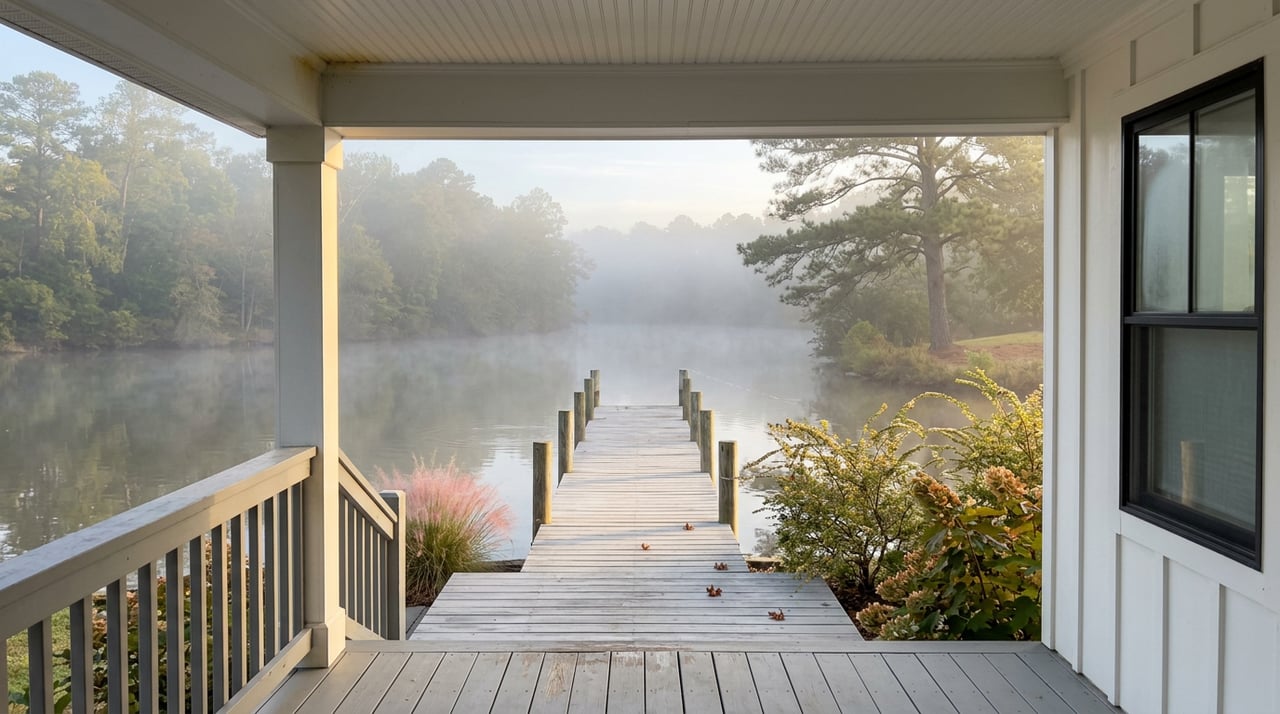
Ask most buyers what a lake view is worth and they will guess double. Sometimes triple. That is the going assumption anywhere else in Georgia where waterfront inventory is scarce and demand is loud.
Jackson Lake breaks that assumption. As of March 2026, the median sale price for a home anywhere in Butts County sat at $297,000, up 14.4 percent from the year before. Waterfront listings on the lake itself, the actual docks-and-shoreline properties, carry a median closer to $325,000. That is a $28,000 gap for direct lake access in a county where water frontage is supposed to command a premium buyers can feel in their monthly payment.
The gap is real, and it is not an accident. It is the price of a set of rules, systems, and inspections that most buyers never hear about until they are three weeks into due diligence. Understanding why the premium is smaller than expected tells you more about what you are actually buying on Jackson Lake than the listing photos ever will.
What the Numbers Are Actually Comparing
Butts County's overall median includes everything from starter ranches in town to acreage tracts along the Towaliga and Ocmulgee rivers. The waterfront median pulls from a narrower, older pool: cottages built decades ago on deeded or leased lots ringing a lake that dates to 1910. Comparing the two isn't perfectly apples to apples, but the direction of the gap still matters. If lake access carried the premium buyers expect from Lanier or Oconee, waterfront medians here would be running well above the county number, not $28,000 above it.
Three forces hold that premium down: a permitting system that governs almost everything you can build on the shoreline, an older housing stock that leans on septic and well systems rather than county utilities, and a lake that behaves differently than the reservoirs most Atlanta-area buyers already know. Each one shows up in the numbers. None of them show up in the listing description.
The Georgia Power Catch Nobody Explains at the Open House
Jackson Lake is not owned by the county or a homeowners association. It is owned and operated by Georgia Power, and that ownership extends to most of the shoreline itself. Before a homeowner can build or rebuild a dock, boathouse, or seawall, Georgia Power requires a permit, and a valid permit card has to be posted and visible from the water for the life of the project.
The rules get specific fast. Georgia Power allows only one shoreline structure per lot, meaning a dock, boathouse, or boat slip, or a single combination structure connecting all three by one walkway. Older docks built under looser standards can stay in place, but only through minor repairs. Anything beyond minor maintenance triggers a full compliance review against current guidelines, which can mean rebuilding to a different footprint than the one a buyer saw in the listing photos.
That distinction matters even more once you know that not every lot on Jackson Lake carries the same kind of ownership.
| Lot type | What you actually own | What it means for you |
|---|---|---|
| Deeded lot | The land and shoreline outright | You hold clear title, subject to Georgia Power's shoreline permits for any dock or structure work |
| Georgia Power lease lot | A long-term lease on land Georgia Power owns in fee | You pay lease terms in addition to your mortgage, and any structure work still needs Georgia Power's separate permit approval |
A buyer comparing two nearly identical cottages, one deeded and one on a Georgia Power lease, is not comparing two versions of the same purchase. They are comparing two different legal relationships to the same shoreline, and the lease version carries an ongoing cost and renewal structure that a deeded lot does not. Confirming which one you are looking at, before writing an offer, is not optional homework. It is the single most consequential fact a Jackson Lake buyer can miss.
A dock permit isn't paperwork you file after closing. Georgia Power requires the card posted and visible from the water for the life of the project, and older structures that no longer meet current guidelines can only be maintained, not upgraded, until they're brought fully into compliance.
Why This Lake Doesn't Swing Like Sinclair or Lanier
Buyers who have shopped Lake Sinclair or Lake Oconee arrive at Jackson Lake expecting the same rhythm: pumped-storage lakes that fluctuate a foot or two on a near-daily basis as power generation demands shift. Lake Lanier operates on an entirely different system, a Corps of Engineers reservoir that draws down several feet every winter for flood control, sometimes leaving ramps and docks sitting on dry ground until spring rains bring the level back.
Jackson Lake runs on its own schedule. Georgia Power does periodically lower the lake for maintenance, dam surveys, or shoreline work, typically on a multi-year interval rather than an annual one, and those windows are announced well in advance so homeowners can plan dock repairs around them. Outside of those maintenance windows, the lake holds close to full pool far more consistently than a daily-fluctuation lake like Sinclair or a flood-control reservoir like Lanier.
That stability is a real value driver. A dock that sits in water most of the year, rather than mud for months at a stretch, is worth something to a buyer who wants to use the lake, not just look at it. It is one of the few factors on this list actually working in favor of the waterfront premium rather than against it. It just isn't enough, on its own, to close a $28,000 gap once the other costs stack up.
The Two Systems That Quietly Erase the Premium
Jackson Lake's older cottage stock means most waterfront homes run on well water and septic systems rather than county utilities. Those two systems are consistently flagged by lake-area buyers and their inspectors as the source of the most expensive post-closing surprises, and the cost spread is wide enough to matter. A septic inspection typically runs a few hundred dollars. A septic system that fails that inspection and needs replacement can run into the thousands, sometimes reaching well into five figures depending on soil conditions and system size.
HVAC tells a similar story. A cottage that looks move-in ready on a mild afternoon showing can be hiding a decades-old unit that was never touched during a string of prior sales. On a lake where many homes were built as weekend retreats rather than primary residences, deferred maintenance on both systems is common enough that skipping the inspection isn't a shortcut. It's how a buyer ends up absorbing the very costs the lower purchase price was supposed to offset.
This is the mechanism behind the $28,000 gap. Waterfront listings look like a smaller premium than the view alone would justify, and the reason is that the premium is already being spent, quietly, on the systems buyers have to fix once they own the place.
What This Means Cove by Cove
Jackson Lake isn't priced uniformly, and the named coves carry real differences a countywide median can't capture. The Tussahaw side tends toward quieter, shallower water favored by anglers and buyers who want fishing and birdwatching over high-speed boating, and pricing there reflects that calmer use case. Sections closer to open water command a premium for what local listings call big water views, sweeping sightlines with more boat traffic to match.
Turtle Cove offers the clearest example of how wide the internal spread can run. Off-water lots in that subdivision that haven't been built on in decades can trade for a few thousand dollars, while a dockable waterfront lot with frontage at the project boundary, the point where a double covered dock becomes permittable, can command well over $100,000 for the lot alone. The difference isn't the neighborhood. It's the shoreline rights attached to that specific parcel.
For a buyer working with a fixed budget, that spread is an opening. An off-water or shallow-cove lot inside the same community can deliver lake living, and access to shared amenities, at a fraction of what a big-water dockable parcel costs. For a seller, it means two houses a quarter mile apart can carry very different valuations, and pricing a listing without accounting for cove, water depth, and dock status leaves real money on the table in either direction.
Frequently Asked Questions
Is a Georgia Power lease lot a bad idea? Not necessarily. Many longtime Jackson Lake owners hold lease lots without issue. It changes the cost structure and the paperwork, not the livability, but it needs to be understood and priced into the offer before you sign anything.
How do I find out if a home is on a deeded or leased lot before I make an offer? Georgia Power's Lake Jackson Resources Office maintains records on lease and license agreements tied to specific parcels. Confirming lot status early, alongside a title search, avoids surprises during closing.
Does every waterfront home on Jackson Lake need septic? Most of the older cottage stock does, since county sewer doesn't reach much of the shoreline. Newer construction on some parcels may have access to water and power at the street with septic still required for wastewater, so it's worth confirming for any specific listing rather than assuming either way.
If you're weighing a Jackson Lake purchase or thinking about what your own waterfront property is actually worth once these factors are priced in, the team at The Legacy Real Estate Group works this market year round. Get your instant home valuation and let's talk through what your specific cove, lot type, and dock status mean for your number.